
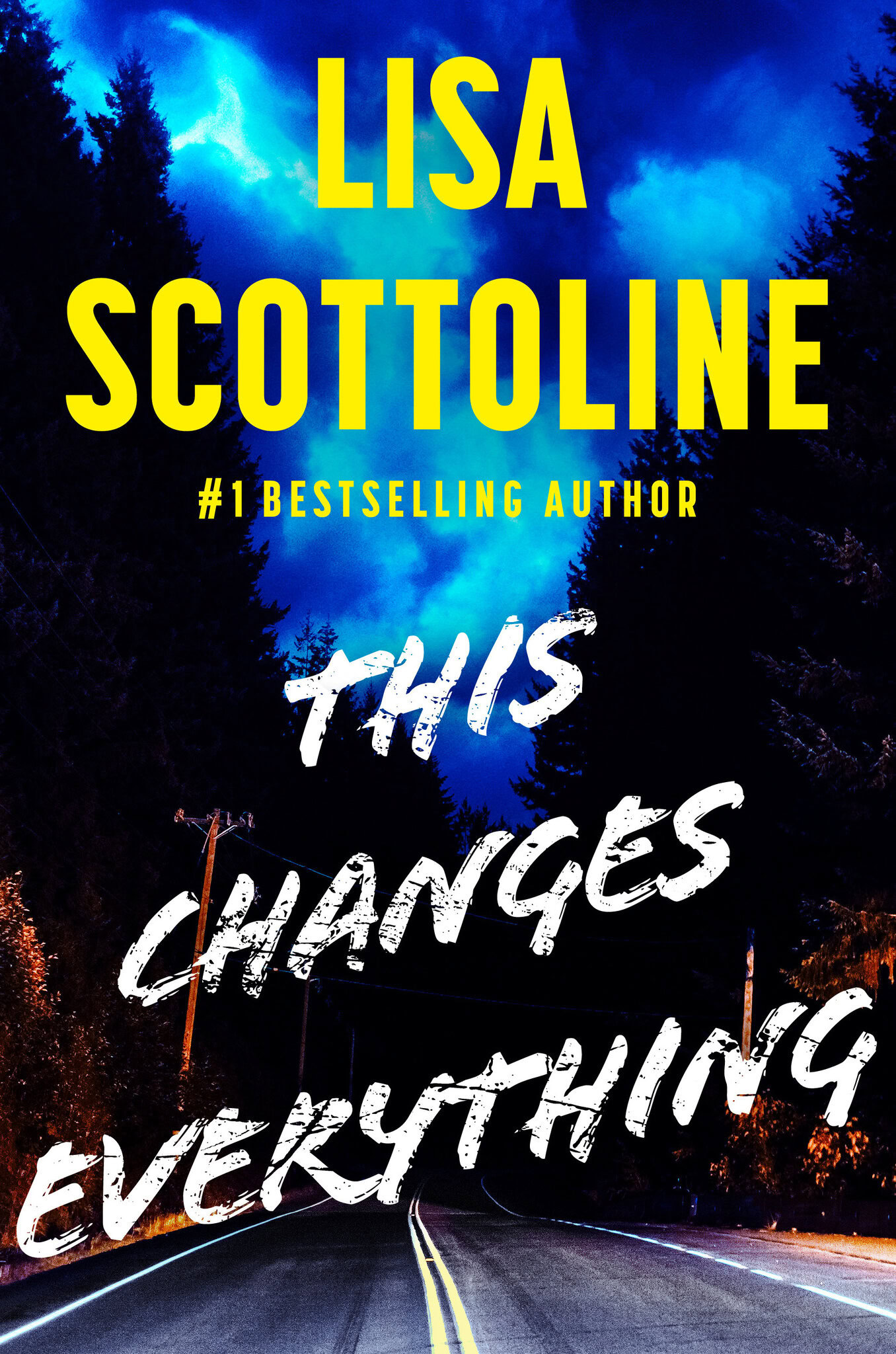
On Sale Now
★ USA Today Bestseller
★ A Barnes & Noble’s Best Mystery & Thriller Book of the Year 2026
★ A Zibby Most Anticipated Book of Summer 2026
“A riveting, deeply felt and empowering thriller that is also a touching ode to female friendship, This Changes Everything is Lisa Scottoline at her best.”
—Laura Dave, New York Times bestselling author of The Last Thing He Told Me
“Lisa Scottoline always delivers the fastest, twistiest reads packed with brilliant characters to root for.”
—Lisa Jewell, #1 Bestselling Author of Don’t Let Him In
“With This Changes Everything, her immersive and atmospheric new domestic thriller, Lisa Scottoline transports us from Tuscany to rural Pennsylvania and gives us characters to root for, a compelling mystery to solve, and a deeply-felt meditation on the meaning of motherhood and enduring women’s friendships. As always, Scottoline scores a bullseye. Bravissima!”
—Mary Kay Andrews, New York Times Bestselling Author of Road Trip
“This Changes Everything has it all – terrific twists, a breathless pace and a whole lot of heart. This story of a grievous crime and an extraordinary friendship could make me gasp on one page and smile on the next. How rare, yet wonderful: A wildly entertaining thriller with real emotional power.”
—Ken Jaworowski, Edgar-Nominated Author of What About The Bodies
“The incomparable Lisa Scottoline delivers a breakneck thriller in which one woman risks everything for justice, as she’s pitted against a twisted, deadly conspiracy.”
—Dennis Tafoya, Critically-Acclaimed Author of Dope Thief
About the Book
In this “riveting, deeply felt and empowering thriller” (Laura Dave) from #1 bestselling author Lisa Scottoline, who “always delivers the fastest, twistiest reads” (Lisa Jewell), a woman risks her life to help her best friend find justice for a tragic crime–and realizes she has more power than she ever knew.
Julia Pritzker loves her new life as a wife and mother in beautiful Tuscany—except that she misses her best friend Courtney, back in the States. One night, Julia calls Courtney and reaches her as she’s arriving at her grandmother’s farm in Pennsylvania.
Then the unthinkable happens. A dreadful premonition overwhelms Julia moments before Courtney enters the house—and makes a heartbreaking discovery. Her beloved grandmother has been murdered, and the killer is escaping out the back door.
Julia flies home the next morning to support Courtney in her grief. The local police believe the murder was a botched burglary, but the women suspect something much more sinister and enlist hotshot Philly lawyer Bennie Rosato to assist. In addition, Courtney entreats Julia to trust her psychic intuition to point her to the missing pieces of this dark puzzle.
But in a town filled with explosive secrets, events take a deadly turn, and Julia becomes the target of a murderous conspiracy. She ends up fighting for her life, with no one to save her … but herself.
Only a blockbuster talent like Lisa Scottoline can tell this gripping and layered of a story, combining a woman’s search for truth with the revelation of her own empowerment, as well as the enduring strength and joys of female friendship.
Discussion Guide
QUESTIONS FOR BOOK CLUBS
- Let’s talk about female friendship, because that’s been such an important part of my life. I have friends that are of 30 years standing and even 40. Julia and Courtney are much younger, but they feel as if their friendship has born the test of time, too. How important are female friendships in your life? Are they as important as relationships to men in your life? How about your children? I feel like sometimes we put women second to other relationships. What do you think about that? How would your life be different if you did not have girlfriends?
- Julia realizes that maybe she called Courtney for a reason and that maybe it was the nature of a premonition. Have you ever had a hunch that something is wrong or something is going on that is somehow beneath the surface? Is this female intuition, which is what we used to call it, or is it truly something extraordinary. Or is it that all of us women have this extraordinary power? Or is it that some people are especially attuned to the needs of others, while some are not? Why don’t we accord our intuitive powers the same legitimacy as our powers of rational thinking? Is it sexist or is it simply science?
- Gianluca says to Julia “You’re a mother. You can’t put your life in jeopardy, any more than I can.” He is essentially reminding her that being a mother should be her top priority. Do you agree with this statement? Would a man be told something like this? How does society influence this kind of expectation?
- Julia calls Courtney and experiences something truly horrific and essentially goes through it with Courtney in real time. Let’s talk about technology. Is this a good thing or a bad thing? Have you ever called your friend at a time when it was incredibly intrusive? Have you ever felt that FaceTime is appropriate at certain times and not at others? Or positively put, have there been times when you have FaceTimed with someone or zoomed with them and felt that you were there for them in a way you could not have been before this technology started? I’m talking about Covid times but not only about Covid times. What about today?
- What do you think about the decision that Julia makes at the outset. She realizes that going back to Pennsylvania might require her to use her intuitive powers but at the same time she wants to help her friend and she is torn. Have you ever helped a friend to your own detriment? Is this a good thing or a bad thing? Or is that what true friendship is all about? Sacrificing for one another?
- Julia is often in situations where she must weigh her personal convictions against her responsibilities to others. What are your thoughts on this conflict? What do you think the right balance should be? Have you ever faced a decision like this?
- What about Julia’s relationship to Leni? Do mothers make different decisions in their life when they have children? Do you? Did you take fewer risks because you mattered so much to somebody? Or did you take more risks because you wanted to show your children that you should take chances in life? Would you have made the choice that Julia did as a mother? What about if you are not a mother? Is this a difference at all? Should it be?
- Let’s talk about ageism. There is a moment when Julia realizes that she is being ageist, and what do we think about this? Do you think she was being ageist or was she just being considerate of the two older women? Or was she simply underestimating them, which is the very definition of ageism? How do we treat ageism in our society and culture? Sometimes I feel that it is viewed more benignly as other forms of prejudice, but is that true? And if it’s true, is it fair?
- Let’s talk about racism, too. Courtney has experienced racism as a biracial woman, and certainly we see that her grandmother did as well. Sometimes I worry that racism and antisemitism are on the rise. How can we combat these things? Is empathy the answer? How can we help each other to see the commonality in our human condition instead of the differences in our exterior? Sometimes I think that racism not only degrades its victims, but even those who perpetrate racism. The world view is narrower, and they deprive themselves of knowing people and reaching for opportunities that they would otherwise achieve. Do you agree or disagree? Why?
- This novel explores themes such as loyalty, truth, love, and personal sacrifice. How do these themes influence the characters of Julia, Gianluca, Courtney, and Paul? In what ways do these characters evolve over the course of the story? Do all of the characters demonstrate growth, or do some remain unchanged? Who changed the most?
- I believe that we live in the greatest country on earth, and I think that I am a patriot. I believe in law and in the Constitution. As a lawyer, I took an oath to uphold these things. Obviously, these notions are in flux in our turbulent times, and unfortunately, they seem to change with political identities. What do you think about all of this polarization? Can we ever get past it? Do you have any ideas? How? We are approaching our nation’s birthday. What do you think of the fabulous American experiment? Will you celebrate this birthday and how?
- Let’s talk about adoption. I have experience with adoption in my extended family, and I know that it can be wonderful, or sometimes less so. Do you have any experience with adoption in your own family?
Could you relate to Julia’s struggles to integrate her identity, as between Italy and America? And as between her birth mother and her adoptive mother? - Let’s talk about Gianluca and marriage. What did you think of him as a husband? Do you think he was fair to Julia as she made her decisions and her journey in America? Or do you think he was too demanding or controlling? I’m divorced twice so I’m no marriage expert, lol, but how important is compromise in marriage? And what does that actually mean? Giving each other the freedom to do the things each person wants to do, in alternating fashion? Or compromising on each matter, so it is a halfway negotiation each time? Do you have faith that Julia will have a solid marriage in the future?
- In the novel, Courtney gets involved with her old flame. What do we all think about old flames? Do you have one that got away? Is that person better left gone or do they get deified because they never got chosen so you didn’t know them long enough for them too screw up?
- Let’s talk about the ending of the novel. Were you surprised by Courtney’s story at the end? Did you feel that the entire novel had a sufficient payoff for you, emotionally? Did you think it was too happy, or too sad? Or just right?
- The title for this thriller is This Changes Everything. It is an intriguing title that doesn’t give away much of the story. Why do you think she selected this title? What “changes everything”?