
Big News: Lisa's new psychological thriller THE UNRAVELING OF JULIA is on sale now!

Column Classic: Christmas With The Flying Scottolines

By Lisa Scottoline

It’s time you knew the truth.

My childhood Christmases were not the norm.

I’m reluctant to tell you because it makes the family look bad.

But I’m a fan of the truth, especially if it’s funny.

Here’s what happened.

When I was little, The Flying Scottolines were a family of four, living in a tract house in Delaware County, Pennsylvania.  But my mother had a very large family and she was the youngest of nineteen children.

Yes, you read that correctly.

Nineteen.

I had eighteen aunts and uncles.  Their age span was so large that some were dying while others were being born.

Okay, maybe that’s an exaggeration, but not by much.

What does this tell you about my family?

I don’t even want to know.

Let’s just say they were good Catholics.

Maybe too good.

What does that tell us about my grandmother?

That she had more estrogen than the northern hemisphere?

Can you imagine being pregnant nineteen times?

It’s like a puppy mill, only with babies.

By the way, my grandmother was married twice.  Her first husband died.

You can guess how.

His heart wore out.

Before anything else, evidently.

I would’ve said, Dude, before bedtime, maybe read a book instead?

Anyway, when I was growing up, most of the aunts and uncles would come to our house for Sunday dinner and on holidays.  The house would burst with colorful Italian relatives, like in an Olive Garden commercial but not as well-dressed.

Everybody brought potluck, which meant that we had 37 different kinds of pasta. 

I adored all of my aunt and uncles, but my favorite was Uncle Mikey, the Fun Uncle. 

He drove a convertible Thunderbird, love to sing and dance, and did God-knows-what for a living.  He loved to play with me and my brother, tickle us, and tell us dumb jokes.  But best of all, he always brought us presents on Christmas Eve, like Santa, only smoking a cigarette.

All the other aunts and uncles would give us a Christmas gift by placing them under the tree for us to open on Christmas morning.

But not Uncle Mikey.

He would bring his gifts unwrapped, so we could play with them right away.

Of course, we loved that, as kids.

Delayed gratification was not in our vocabulary.

I always noticed some tension between my parents and Uncle Mikey on Christmas Eve, and one year, the presents from Uncle Mikey stopped abruptly. 

Bummer. 

I asked my mother why, and that’s when she told me that Uncle Mikey’s presents “fell off a truck.”

Not that that explained anything.

I remember thinking that Uncle Mikey was the luckiest guy ever, always driving around behind trucks full of toys, just when things started falling off the back.

What a guy!

And he must’ve been the greatest catch, too, because when the toys fell off the truck, he caught them.

Merry Christmas!

Some kids believed in Santa, but I believed in Uncle Mikey.

I didn’t care where the presents came from, only that I got them.

Evidently, Uncle Mikey felt the same way.

Then one day, after I had become an adult, I heard the term “fell off a truck” used in a movie.  And I learned that it meant the goods were stolen.

Which is when I realized that Uncle Mikey wasn’t such a good catch, after all.

No wonder Mother Mary made him stop.

And no wonder the presents were never wrapped.

And no wonder they were always the best.

Because they didn’t cost him anything.

The Flying Scottolines were receiving stolen goods.

Luckily we didn’t end up behind bars.

And so you get the idea.

That’s who we were.

Are you impressed yet?

The truth is never impressive.

It’s just real.

And sometimes funny.

Copyright © Lisa Scottoline

Column Classic: Thanksgiving

By Lisa Scottoline / Francesca Serritella

Here is a true classic and the first column Francesca wrote while in college, before she became a regular contributor.

Intro from Lisa Scottoline

Thanksgiving is about family, so I thought I’d ask my daughter Francesca for her thoughts about the day.  We spend so much time talking to and teaching our children that sometimes it’s nice just to ask them what they think, and listen to the answer.  So take a minute this Thanksgiving to ask your own baby birds what they think about the day, and listen to whatever they chirp up with. 

Because I bet that the thing that you’re most thankful for is them. 

Column Classic: Thanksgiving

By Francesca Serritella

My family is small.  Since it’s only my mom and me at home, our Thanksgiving has never been the Martha Stewart production it can be for some other families.  My dad’s family has Thanksgiving in New York; my grandmother and uncle have Thanksgiving in Miami.  My mother and I buy a last-minute turkey, make up some wacky ingredients for a stuffing, and eat together with Frank Sinatra playing in the background and a lot of warm, furry dogs warming our feet.  It has always been nice, and I know we’re lucky to have each other, but sometimes it has just felt small.

Until Harry.

Harry is our neighbor, he’s in his eighties, and we got to know him from running into him when we walked our dogs.  He used to go for a long walk every day, waving a white handkerchief so cars would see him.  He would stop to chat with us, always cheery and warm, even when the late-autumn wind made his nose red and his eyes tear.

A few years ago, my mom invited Harry to our Thanksgiving dinner, and he arrived at four o’clock sharp, wearing a cozy and Icelandic sweater and graciously removing his Irish tweed cap as soon as he came inside.  During dinner, my mom asked him about his hobbies, and to be honest, I didn’t expect this to be the most thrilling conversation topic.  After all, my grandmother’s hobbies are crosswords and yelling at my uncle.  But Harry’s face lit up at the question.

“I’m a Ham!” he said.

We didn’t get it.

And with that, Harry turned into a live-wire.  He talked about his hobby as a Ham Radio operator, a mode of amateur radio broadcast first popular in the 1920s.   Harry told us all about using radio technology while serving in WWII, and we sat, rapt, as he described sending a signal into the air, bouncing it off the stratosphere, and bending it around the earth.  He seemed like Merlin, hands waving in the air—his fingers had lost their quiver and his watery eyes were bright and shining.

Well-meaning, but being somewhat of a teenage buzz kill, I asked, “Have you ever tried email?  Wouldn’t that be easier?”

No, he said.  He enjoys the effort—a foreign concept in my wireless Internet, instant-messaging world.  Even though Ham radios can communicate through voice, he still uses Morse code sometimes, just for the fun of it.  Most of all, he enjoys belonging to the community of Hams.  “I get to meet people I would never meet.  I have friends around the world.”

That night, it didn’t matter that Harry and I didn’t share a last name, or that we didn’t share the same relatives or the same nose.  That Thanksgiving, he was family.  He still is.

What Harry and my mother taught me that Thanksgiving, whether they knew it or not, was that you don’t just get your family, you can create your family.  We do it all the time without realizing it; we form bonds with the people we work with, live with, learn with.  I’ve felt homesick up at college, but I’ve also created my own little family of friends at school.  I hope all those brave soldiers overseas have found second families in their comrades, people to support and lean on when they’re forced to be away from loved ones at home. 

These second families don’t replace our first one, they just extend it. 

It wasn’t until that Thanksgiving with Harry that I really got it: there are no rules for what or who makes a family, no limit on love.  The holidays especially are a time when we can reach out and say “thank you” to all the people who make up our many families.  And sometimes, if you’re lucky like me, Thanksgiving can even be a chance to set an extra plate at the table.

Looking out the dining room window, I can barely see Harry’s house for the trees.  But inside that house is a man who is not alone.  There lives a man who is an expert at reaching out to people, whether by angling radio waves around the globe, or by flagging us down on a walk around the block.  He has us, he has our other neighbors, he has friends around the world.  Even better, we have him. 

And for that, I am thankful.

Copyright © 2007 Lisa Scottoline / Francesca Serritella

Classic Column: Tryhard

By Lisa Scottoline

Mother Mary knew the secret to great parenting.

Don’t try too hard.

And I mean that in the best way.

The thing that both of my parents gave us in abundance was love.

That came naturally to them. 

They didn’t have to try very hard at all.

My brother Frank and I were adored, unconditionally.

They thought everything we did was great.

It was the only thing they agreed on, until they divorced.

Their love for us was all out of proportion with any reality.  For example, I remember getting ready with my brother to go with my father to the World’s Fair in New York City.

Yes, that would be in 1964.

Welcome to The History Channel, or in other words, my life.

I was born in 1955, so I was nine years old at the time.

Believe it or not, I just had get a pencil and paper to do the math, including carrying-the-one, which shows my great affection for you.

I remember telling my mother that I was excited about seeing New York.

And I remember distinctly what she said to me, which was, “Honey, New York is excited to be seeing you.”

Wow.

That’s love.

Or maybe delusional behavior.

But either way, I grew up feeling pretty great about myself.  

And not because I got good grades in school or for any other reason, except the fact that I breathed in and out.

My father was the same way.

I remember that after I had become an author he would come to my signings, and someone said to him, “you must be very proud of your daughter” and he said, “Lady, I was proud of her the day she came out of the egg.”

I’ve told that story before, I tell it all the time, because I think I have the same attitude, and think it’s one of the reasons that Francesca and I are so close.

I just adored her, the moment she came out of the egg.

I still do.

And I said all the dumb things to her that my mother said to me, like “don’t study so much” and “it doesn’t matter whether you get A’s, just so you’re happy” and “stop reading so much, it will ruin your eyes.”

And paradoxically, Francesca turned out to be a wonderful student and accomplish great things, despite me telling her that she didn’t need to bother.

And I can’t say I caused that, or even that it planned it, only that when I think back to my childhood, I realize that there was absolutely no trying going on in my household, at all.

We just were.

And that applied to little things as well, like Halloween costumes.

Nowadays, Halloween costumes have been raised to an art form and there are parades in my town, where they give out a variety of prizes for the most original costume and such.  All of the costumes are homemade, and I can see how hard the parents and kids tried to make a wonderful costume.

But we Scottolines never tried that hard.

For Halloween’s when I was growing up, my mother went to Woolworth’s and bought a costume in a box.  It had a plastic mask that was stiff and attached to your face with a cheap piece of elastic that would undoubtedly break by the end of the evening.

Which was fine because the mask was too hot to wear anyway.

You could’ve welded in my Halloween mask.

I remember being Cleopatra five years in a row, and thinking back on it now, I realize I wore the same costume.  

I mean the same exact costume, which my mother must have re-boxed after Halloween and put away, only to present to me the next October.

“Cleopatra!” I would say with delight, each time.  

Because for me, Halloween was when you got to be Cleopatra.

No one ever suggested you could actually change costumes, and I couldn’t imagine why you would want to.

If you could be Cleopatra, why would you be anybody else?

I had diva tendencies even then.

Which Mother Mary evidently encouraged, being something of a diva herself, even though she was only 4 foot 11 inches.

Size really does not matter, people.

The costume was a sheath of turquoise polyester with pseudo-Egyptian hieroglyphics on the front, and the mask was authentically Cleopatran because it had triangle hair on either side of the face, a snake for a headband, and really bad eyeliner.

And I remember loving Halloween, with my father taking us from house to house, me swanning around in my Cleopatra dress and my brother in his pirate headscarf with a fake-silky blouse.

He was a pirate for five years in a row, too.

That was before we knew he was gay.

But he did look damn good in that blouse.

We’d carry paper bags to collect the candy and orange cartons to collect pennies for UNICEF, though we had no idea what that meant, only that it was a good thing to do and made a lot of noise when you shook the container.

All my memories of Halloween, like most of my childhood, are happy, filled with polyester, preservatives, and sugar.

We were happy because we loved each other and it showed.

My parents told us so, and hugged us, and kissed us.

When we fell and skinned a knee, it was a tragedy.

No injuries were ever walked off in the Scottoline household.

They were fussed over, worried about, and cured with food.

No failures or setbacks were ever shrugged off and anytime we were rejected by anybody or anything, fists were shaken.

“It’s their loss,” my father would always say.

And my mother would curse. 

One time, in my lawyer days, she wanted to go to my law firm to yell at one of the partners for working me too hard.

I stopped her, saving the day.

For them.

Because an entire law firm was no match for my mother.

Now, that’s love.

Copyright © Lisa Scottoline

Column Classic: Homey for the Holidays

By Lisa Scottoline

The holidays are coming.

Do you feel happiness?  Or pressure?

If the latter, you’ve come to the right place.

Because Mother Mary has the cure.

Let me explain.

The horror begins at Halloween.

And not the fun kind of horror, which involves kids in costumes and fun-size Snickers bars, but the kind that tells you you have to go apple-picking, then come home and make an apple pie, but you’re not allowed to eat it because it’s too fattening.

Or the kind that tells you you have to visit a pumpkin patch, pick a pumpkin, then come home and carve it, then bake the seeds into snack that nobody wants.

Mind you, I’m not putting any of these things down.

I go by the motto, Don’t Yuck My Yum.

The Internet definition of the term is, don’t hate on things that people love.

And I totally agree with that.

So if you want to go crazy on Halloween, decorate your house, wear funny costumes, and even throw a party, go for it.

But I was in the mall yesterday, and everywhere I turned were signs for the holidays, and all of the signs were pushing one thing, but it wasn’t love, peace, or understanding.

It was perfection.

One sign said, MAKE YOUR HOME PERFECT FOR HOLIDAY ENTERTAINING!

And another one promoted gifts that were “absolutely perfect for the holidays.”

I even saw a display for candles that smelled “holiday-perfect.”

That’s not even good grammar.

Evidently, your house not only has to be perfect, it has to smell perfect.

My house smells perfectly like dogs.

Is that perfect enough?

I want to talk to the people who feel the pressure for holiday perfection, beginning about now.

Because you don’t have to be perfect.

Instead, you can enjoy the holidays in a manner that doesn’t involve a glue gun.

Again, I know lots of people who like to decorate their house for the holidays, and they should enjoy themselves.  But if you don’t enjoy that, you shouldn’t feel pressure to decorate.  And the last thing you need to worry about at the holidays is perfection.

I’m here to tell you it’s okay to be lazy.

Put your feet up.

Make eggnog and drink it all yourself.

Or better yet, buy eggnog and drink it all yourself.

Because it comes down to the question of what you think is perfect in a home, and Mother Mary taught me that your home is already perfect.

That is, if you’re in it, and so are the people you love.

If there are people you hate in your home, you should divorce them.

To return to point, Mother Mary did not do anything for the holidays except start cooking.  She loved to cook, and we loved to eat, so it worked out perfectly.

She didn’t decorate for the holidays in any way.

We got a Christmas tree only the night before, and you would have liked our tree, if you really like tinsel.

Our tree was covered with tinsel.

You would think Reynolds Wrap came over and threw up.

And I remember the tinsel was super heavy, probably because it contained lead.

And maybe even asbestos.

I saw an ad for holiday candles, and it said: “Nothing is quite as cozy as a candle-lit abode, and the decadent aromas of the winter season should be embraced in your favorite spaces.”

I’m so confused by this, I don’t know where to start.

I love candles as much is the next girl, but who has a candle-lit abode?

And what if your “favorite space” isn’t your candle-lit abode, but the crook of Bradley Cooper’s neck?

It could happen, people.

And as for decadent smells, don’t get me started.

I remember with great nostalgia, the decadent smells of the holidays in our house, when I was growing up.

The aroma of ravioli was in the air, and also the smoke of More 100 cigarettes, courtesy of Mother Mary.

Bottom line, Christmas at the Flying Scottolines may have been carcinogenic.

But there was love, and carbohydrates.

And that was enough, and everything.

Happy Holidays!

Copyright © Lisa Scottoline 2019

Column Classic: Sucking Up

By Lisa Scottoline

Good news! Lisa is just putting the finishing touches on her new novel, and will be writing new columns ASAP!

I just read a story about a man who thought he had a lung tumor.

But it turned out to be a toy he’d inhaled as a child.

This is an absolutely true story.

Actually, all the stories in these columns are true, but most of them are bizarre things that happened to me.

This is a bizarre thing that happened to someone else.

It turns out that there was a postal worker in Britain who had been treated for a bad cough, and an X-ray revealed a mysterious mass in one of his lungs. The doctor thought it was a tumor, performed a bronchoscopy, and found a tiny toy cone from a Playmobil set. Which the man remembered getting for his seventh birthday, forty years before.

Wow.

The doctors took out the cone, and the man’s cough disappeared.

Plus he got his toy back.

Do endings get any happier than that?

Or harder to believe?

He couldn’t remember eating the toy cone, but obviously he must have.

I have that problem too.

I never remember the things I eat.

I could swear I’m not eating anything, but mysteriously, I just gained five pounds.

I must have eaten the entire Playmobil dollhouse.

And the dolls.

Plus the play and the mobil.

It was also incredible that the toy cone didn’t go into his stomach, but into his lungs.

That’s another problem I have.

Anything I eat goes into my hips.

But the story got me thinking about random toys I could’ve eaten at that age.

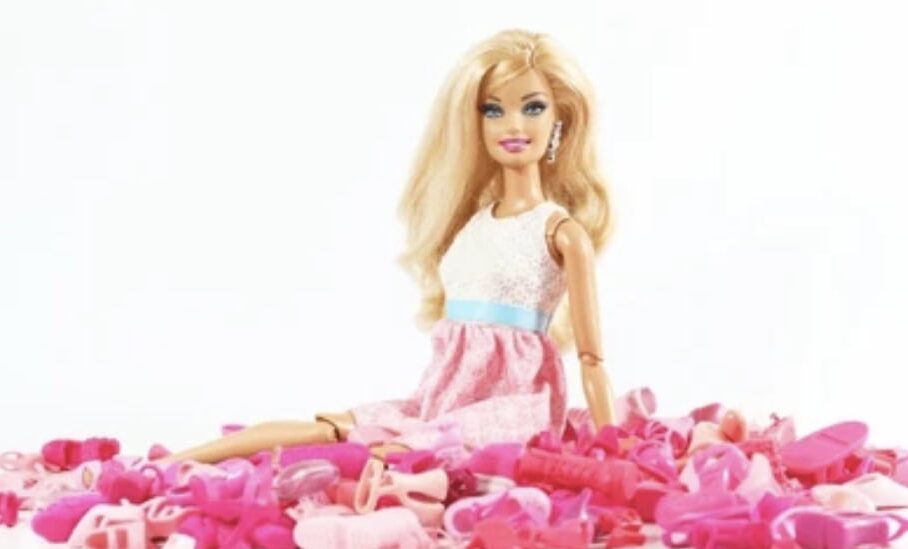
Barbie comes immediately to mind.

As in, Barbie shoes.

You remember Barbie shoes, don’t you?

They were plastic high heels that came in different colors and never stayed on her foot.

Maybe because she was permanently on tiptoe.

Or maybe because high heels aren’t worth the trouble.

I loved everything about Barbie, but I was fixated on her shoes, which I collected and sorted by color.

I took better care of Barbie’s shoes than I do of my own.

And weirder than that, I also had a habit as a child of walking on tiptoe.

Like, all the time.

I remember my mother and father being concerned about it and even taking me to a doctor.

Which was so not the Scottoline way.

We never went to doctors because Mother Mary believed in the healing powers of Vicks VapoRub.

I’m surprised she didn’t rub it into my feet and call it a day.

My entire childhood smelled like camphor and tomato sauce.

Anyway, the doctor said that there are a percentage of kids who are “toe-walkers,” that my parents shouldn’t worry about it, and I would grow out of it by age five.

He was partly right.

They shouldn’t have worried about it, and they didn’t, after that.

But I never grew out of it.

I still do it, even today.

Not all of the time, but sometimes.

Weirded out yet?

I never even realized I do it until I was speaking at a book signing and people started asking me why I was standing on tiptoe. And I realized that I speak on tiptoe at most of my signings, and I’m the most comfortable that way.

I looked it up online and it says that there are adults who toe-walk and that it doesn’t indicate an underlying neurological problem.

Obviously they don’t know me that well.

The articles say that it can mean your Achilles tendon is too short, but I don’t know how long my Achilles tendon is, and in any event, I’m short too, so my Achilles tendon probably matches me.

Otherwise how would it fit in wherever it is?

You see I’m no biologist.

Online it says that adult toe-walkers with an unknown cause are called idiopathic toe-walkers.

There’s no need for name-calling, Internet.

In any event, I don’t know why I do it.

Maybe to feel taller.

Or maybe in my mind, I’m wearing Barbie shoes.

At least I’m not eating them.

Copyright © Lisa Scottoline

Column Classic: Junk in The Trunk

By Lisa Scottoline

If Freud wanted to know what women want, he could have asked.

If he’d asked me, I would have answered:

Another kitchen cabinet.

And I just got one!

Here’s how it happened. 

It was about ten years ago that I remodeled my kitchen, adding white cabinets and a trash compactor.  To tell the truth, I don’t remember wanting a trash compactor and think it was Thing Two who wanted a trash compactor, but I’ve blamed enough on him, so let’s just say I wanted a trash compactor.

At the time, my kitchen contractor said, “I’ll install this trash compactor for you, but I bet you’ll never use it.”

“I’m sure I’ll use it,” said I.  And I probably added, “Plus it will give me something to blame on somebody, down the line.”

In any event, the trash compactor got installed, and it came with two free bags, which I promptly lost. 

Ten years and one divorce later, it turns out that the contractor was right. 

I should have married the contractor.

But to stay on point, I never used the trash compactor.  Not once.  I even forgot it was there until three months ago, when it began to emit a mysterious and foul odor.  I searched the thing and could find no reason for it to be smelly, but I washed it inside and out anyway.  Still the smell got worse and worse, until it was so bad I could barely eat in the kitchen.  Then one day, the electrician came over to fix a light and he said,  “Smells like something died in here.”

Bingo!

The electrician showed me that you could slide out the compactor, which I hadn’t realized, and when we did, we found behind it an aromatic gray mound that used to be a mouse.

Eeek!

The electrician threw the dead mouse away, and I cleaned the trash compactor all over again, but it still stunk worse than my second marriage, which I didn’t even think was possible, so I threw the trash compactor away, too. 

Which left an oddly empty space on my kitchen island, a blank square among the white cabinets, like a missing tooth. 

I called the kitchen contractor, whose phone number I still had from ten years ago.  As soon as he heard my voice, he said, “Told you,” and came right over.

Last week he installed a new cabinet, including a drawer, then asked, “What are you going to use it for?”

”I’m not sure yet,” I told him, excited by the possibilities.  It was almost too much to hope for – a nice empty cabinet and a whole extra drawer.  After he had gone, I pulled up a stool and contemplated my course of action.

The decision required me to consider the problem areas of my kitchen cabinets, which are many.  My pot-and-pan cabinet is a mess because I hate to stack pots and pans in their proper concentric circles.  I just pile them up any way, playing Jenga, only with Farberware.  Also I can never figure out how to store pot lids, so I stick them in upside down, setting them wobbling on handles like the worst tops ever.  Every time I open the cabinet door, they come sliding out like a stainless steel avalanche. 

I also have a cabinet containing Rubbermaid and Tupperware, but it’s all mixed up, so that Rubbermaid lids are with Tupperware containers and Rubbermaid containers are with Tupperware lids, making the whole thing feel vaguely illicit, like a orgy of plastic products. 

Then I have a cabinet of kitchen appliances I have never used once in my life, but feel compelled to keep close at hand, namely a juicer, a waffle iron, and a salad shooter.  You never know when you’ll have to shoot a salad.

My kitchen drawers are equally problematic. I have one drawer for silverware, and four others for junk, junk, junk, and junk.  All the junk drawers contain the same junk, just more of it, namely, pens that don’t work, pencils that have no point, extra buttons that go to clothes I’ve never seen, rubber bands I got free but can’t part with, menus for restaurants I don’t order from, and pennies.

In other words, it’s all essential.

I think I know what to put in the empty cabinet.

Trash compactor bags.

Copyright © Lisa Scottoline

Column Classic: Reading is Fundamental

by Lisa Scottoline

With the start of a new school year upon us, I’m reminded about Mother Mary and her grammar patrol.

Cute owl wearing glasses reading a book, cartoon style

Mother Mary has a new job that benefits us all.

Before I reveal it, let me explain that over the years I’ve made a few author friends, and I buy their books and get them to sign them to my mother, which gives her a big charge.  Last month I shipped her five books, including my newest one, then I called to ask her, “How’d you like my book?”

“I loved it, it was great!.  But I have some corrections for it.  And for the others.”

“Corrections?  How many?”

“About five.”

“Five corrections?” I ask, surprised.  “Like typos?  That’s bad.”

“No, five pages of corrections.  And for the others, too.”

I am astounded.  “Five pages of typos?”

“Not typos, corrections, and I have five pages per book.  So, twenty-five pages of corrections.”

Now, I officially don’t get it.  “Give me an example of something you corrected.”

“Okay, in your book, you use the word ain’t.  Ain’t is not a word.”

“Is it used in dialogue?”

“Yes.”

“Then, it’s fine.  That’s how the character speaks.  That’s not a mistake.”

“Yes, it is.  Nobody should use the word ain’t.  You know better than that, you went to college.  I’ll mail you the sheets.  You’ll see.”

“Okay, send them.”

“Ain’t!  Hmph!”

So Mother Mary mails me the alleged corrections, twenty-five pages of notebook paper, each line written in capitals in a shaky red flair.  AIN’T IS NOT A WORD! is the most frequent “correction.”  A few are typos, but the rest are editorial changes, different word choices, or new endings to the plot.

Bottom line, Mother Mary is a book critic, in LARGE PRINT. 

Still, I read the sheets, touched.  It must have taken her hours to make the lists, and it’s really sweet.  I call to tell her so, which is when she lowers the boom:

“You need to send the lists to your friends,” she says.  “Your friends who wrote the other books.  They should know about the mistakes, so they can fix them.”

“Okay, Ma, you’re right.  Thanks.  I will.”

I don’t like lying to my mother, but I’m getting used to it.  I figure I’ll put the sheets in my jewelry box, with daughter Francesca’s letters to Santa Claus.  Those corrections are going to the North Pole. 

Then my mother adds, “You don’t have to worry about the one set, though.”

“What one set?”

“A set of corrections, for your new friend.”  She names a Famous Author who isn’t really my new friend, but Somebody I Wish Were My New Friend.  I can’t name her here, as she will never be my new friend, now.  In fact, she’s probably my new enemy.  Because my mother sent her five pages of unsolicited editorial changes to her terrific, number-one bestseller.

“You did what?” I ask, faint.  “Where did you get her address?”

“Your brother got it from the computer.”

“Her address is on the computer?”

“She has an office.”

Of course she does.  “And you sent it to her?”

“Sure.  To help her.”

I try to recover.  I have only one hope.  “You didn’t tell her who you are, did you?”

“What do you mean?”

I want to shoot myself for never changing my last name.  My last name is Scottoline and so is Mother Mary’s, and the Very Famous Author signed a book to her at my request, so in other words….

“Oh, sure, I told her I’m your mother, in case she didn’t know.”

“Great.”  I sink into a chair.  “And you did that because…”

“Because I’m proud of you.”

Ouch.  I can’t help but smile.  How can I be angry?  I tell her, “I’m proud of you, too, Ma.”

It’s not even a lie.

Copyright © Lisa Scottoline

Column Classic: Lift and Separate

By Lisa Scottoline

Once again, you’ve come to the right place.

If you read this, you’re going to LOL.

But this time, I can’t take the credit. 

Sometimes the world hands you an ace.  All you have to do is set it down on the table and play.

I’m talking, of course, about the SmartBra.

Have you heard about this?  If not, I’m here to tell you that at the recent consumer electronics show, a Canadian tech company introduced a smartbra, which is a bra that is smarter than you are.

Or at least smarter than your breasts. 

Microsoft is reportedly developing a smartbra, too, and I’m sure the other tech companies will follow suit.

Or maybe bra.

If it creeps you out that the male-dominated tech industry is thinking about what’s under your shirt, raise your hand.

Just don’t raise it very fast.

They’re watching you jiggle.

Bottom line, the smartbras contain sensors that are supposed to record your “biometric data” and send it to an app on your mobile device. 

It’s a fitbit for your breasts.

Or a fittit.

Sorry, I know that’s rude, but I couldn’t resist.

Like I said, the world handed me an ace. 

Anyway, to stay on point, the biometric data it monitors is your heart rate and respiration rate, but Microsoft has taken that a step further.  According to CNN, their smartbra is embedded with “psychological sensors that seek to monitor a woman’s heart activity to track her emotional moods and combat overeating.”  In fact, their “sensors can signal the wearer’s smartphone, which then flash a warning message to help her step away from the fridge and make better diet decisions.”

Isn’t that a great idea?

It’s a bra that tells on you when you’re hitting the chocolate cake.

Forgive me if I’m not rushing out to buy one.

I already know when I’m being bad, and I don’t need to be nagged by my underwear.

By the way, the smartbra sells for $150.

If that price gives you a heart attack, the bra will know it. 

Maybe the bra can call 911.

Maybe the bra can even drive you to the hospital.

Don’t slack, bra.

That’s for breasts.

The Canadian company says that wearable tech is the latest thing, and that it developed its smart bra because it had “a plethora of requests from eager women who wanted in on the action, too.” 

Do you believe that? 

I don’t. 

On the contrary, I know a plethora of eager women who wish they didn’t have to wear a bra at all. 

I also know a plethora of eager women who take their bra off the moment they hit the house. 

Plus I know a plethora of eager women who skip the bra if they’re wearing a sweatshirt, sweater, or down vest. 

Finally, I know a plethora of eager women who would never use the word plethora in a sentence.

Okay, maybe I’m talking about myself. 

Frankly, I don’t want “in on the action” if the action means a bra that will tell the tri-state area I’m pigging out.

However, I want “in on the action” if the action means Bradley Cooper. 

And nobody needs a smartbra to monitor what would happen to my heart if Bradley Cooper were around.

By the way, researchers are not currently developing a pair of smart tighty whitey’s for men.

That’s too bad because I have a name for it.

SmartBalls.

But maybe men don’t need underwear with a sensor that detects their emotional changes. 

They already have such a sensor. 

In fact, they were born with it. 

Too bad it doesn’t make any noise.

Like, woohooo!

Copyright © Lisa Scottoline

Column Classic: Extra Extra Crispy

By Lisa Scottoline

My faith in American ingenuity is restored.

We just invented fried butter.

Whew!

You may have been worried that we didn’t have any more tricks up our sleeve, but you would be wrong.  We used to invent things like electricity, heart valves, and polio vaccines, but we’ve finally come up with something useful.

Somebody at the Iowa State Fair developed a recipe for deep fried butter.

It sold like hotcakes.

Fried hotcakes.

What an idea!  How else you gonna meet your daily cholesterol requirements?

They make it by freezing a stick of butter, dipping it in batter with cinnamon and sugar, deep-frying it in vegetable oil at 375 degrees, then drizzling it with a honey glaze.

You know you want one.

The other bestsellers at the state fair were deep-fried pickles, deep-fried corn dogs, and deep-fried macaroni and cheese.

I might move to Iowa.

Land where the tall corn (dogs) grow.

It’s not just state fairs, either.  My favorite fancy restaurant serves microgreens with fried goat cheese.  Guess which I eat first, the microgreens or the fried cheese?  Right, and thank God the fried cheese isn’t micro.

Tell the truth.  Who hasn’t dived into a plate of fried mozzarella sticks?

Bottom line, it’s time to concede that we love fried things.  French fries, fried onion rings, fried chicken.  And we don’t just love fried food, we even love the fried part, all by itself.

Everybody on earth has nibbled the fry off of something.

Case in point, me. 

Back in my non-vegetarian days, I used to love Kentucky Fried Chicken, extra crispy.  Extra crispy was code for really really fried.  When there was no more chicken left, I ate the nuggets of really really fried.  Even after two days in the refrigerator, I ate delicious knots of crunchy, salty, really really fried. 

The chicken was beside the point, because the only thing that mattered was the fried, and that’s true with every fried food. 

It tastes the same. 

Fried.

Yay!

This is why I order shrimp tempura at a Japanese restaurant.  Because all I taste is the fry, and I might as well be at Seafood Shanty.

Tempura is Japanese for corn dog.

We agree that frying will make a good thing better, but the truly amazing thing about frying is that it will make even disgusting things better.

Example?

Calamari.

It’s a squid, for God’s sake.  Have you ever seen a squid?  If you had, you wouldn’t put it in your mouth. 

But fry it, and people fight to get to it first. 

Same thing with softshell crabs.  A softshell is a crab that has recently molted its shell, so that its exoskeleton is still soft.  You wouldn’t normally eat a soft exoskeleton, much less all the stuff that’s inside a crab, namely whatever he ate last. 

Do you think crabs are picky eaters?

I don’t.

So you have to factor that in.

Plus the eyes are still attached. 

Enough said.

If you had to eat a softshell crab as is, you would refuse.  Your better judgment would prevail.

But fried?

Everybody’s there.

The proof is that people in Thailand eat fried bugs.

Now you know why.

Tastes like (fried) chicken.

The next step is only logical.  If frying makes disgusting food delicious, there’s no reason to stop at food, at all.

I’m not only thinking out of the box, I’m thinking out of the refrigerator.

If you can fry squid, you can fry flip-flops.

If you can fry butter, you can fry bark.

If you can fry bugs, you can fry Crestor.

And you’re gonna have to.

Copyright © Lisa Scottoline

Column Classic: Handygirl

By Lisa Scottoline

I just put in a hundred perennials, which if you’re not familiar with gardening terms, means that I never have to do this again for the rest of my life.

Because perennials are supposed to be automatic, in that they come back every summer.

Like a yeast infection.

It took me five days to plant a garden, because I made every rookie mistake possible. 

First, let me just say that I had no idea that gardening is so much hard physical labor.  I toted sod, plants, and big rocks, in ninety degree heat.

Gardening isn’t a hobby, it’s a chain gang.

My back, legs, and shoulders ache, my leg is swollen from a sting, and I got scratches from rose bushes I bought when I was temporarily insane. 

There can be no other explanation for buying a plant that bites.

The problem with gardening is that the very term is a euphemism.

It fools you into thinking that you’ll be swanning around a bunch of flowers.

Wrong.

Remember when you delivered a baby?  It was called labor for a reason, so you had fair warning.  Because it’s work.  There’s pushing and pulling and yanking and profanity.

And that’s just conception.

Sorry.

Anyway, back to my mistakes.  Second mistake, I bought plants online because they were cheaper, then I found out that the nursery near me is going out of business and everything there was 40 percent off.

What I had already spent.

The online plants didn’t come when they were supposed to, so I started thinking I’d need more plants anyway, and I could get them cheap at the nursery. I read through my new perennials books, went to the nursery with my To Buy list, and they had none of them. 

So I bought whatever perennials they had on sale.

It’s the Going Out of Business Garden.

And for what these plants cost, it’s going to put me out of business.

Anyway, the books said I had to take the grass off and make a bed.

I had no idea.  I thought you could just plant flowers in grass.  I should have known I’d screw up.  I never make my bed.

Third mistake, I thought the garden was a big area, but I’m not good at eyeballing it, as my father always said.  Of course I know there are tape measures, but how would you know how many plumbago plants you need to fill a foot of garden?  Until yesterday I thought I plumbago was a back problem.

Now plumbago is giving me a back problem.

Bottom line, it’s a big garden, so I got a great handyman, Dale, to help me, which is what you do when you’re divorced. 

You hire a husband.

Anyway the first thing Dale said was, “there’s a machine that takes off sod.”

Oh. 

So we found out the machine was called a sod cutter, and we rented one right away and started cutting the sod, which is the garden equivalent of scalping your grass. 

It took all day, cutting and hauling the sod, then raking the bed so no grass seeds were left.  Then we started putting in plants, with Dale doing the manly work of digging and me doing the girly work of putting in the potting soil and covering the hole.

I was a cover girl.

Yay!

Next mistake, we used up all the plants I had bought on sale, and still had two thirds of the garden left.  The online plants still weren’t here, so I went back to the garden center and bought more plants.

Three times.

I no longer consulted the books. 

I bought any perennial that wasn’t nailed down.

I would have planted a file cabinet if they’d let me.

But now I’m finished, and it looks beautiful, and it was worth all the trouble, like a brand new baby.

Who remembers their labor anyway?

Okay, I do.

Copyright © Lisa Scottoline